
South Jordan is one of our busiest service areas across Salt Lake County. Lift Right Concrete is the family-owned company we started in 2010, lifting concrete and repairing foundations throughout the city: driveways, front walkways, patios, slab pads, and foundation work across both the original South Jordan neighborhoods and the newer Daybreak communities. Every job gets the same approach: see the property in person, give you an honest written estimate, then fix it right.
Most settled concrete in South Jordan comes back to the same root cause: disturbed soils that didn't fully compact after development.
Like the rest of the Salt Lake Valley, South Jordan sits on the floor of ancient Lake Bonneville. The native ground is a mix of lakebed clays, silts, and sands deposited over thousands of years. That base material is stable when it's left undisturbed, but once it gets reworked during construction (graded, cut, filled, trenched for utilities), it loses density and becomes vulnerable to settlement. Seasonal moisture works into the disturbed soil and consolidates it over years. Periodic seismic activity from the Wasatch Fault (which runs along the east bench of the valley) shakes everything a little tighter. Over time, the soil keeps finding lower and tighter ways to sit, and the slab on top follows it down.
Daybreak is its own story. The community is built on Kennecott's old mine excavated soils, material that was moved during decades of copper mining operations and later regraded for the development. That ground is engineered and compacted to spec at the time of construction, but compaction varies, and the areas immediately around foundations are often the first to show settlement once normal moisture cycles begin. We see this consistently around the perimeter of Daybreak homes: driveway approaches, garage aprons, walkways between the sidewalk and front steps, and the slab pads behind the house.
In both Daybreak and the original South Jordan neighborhoods, settlement usually shows up first at the joints: wherever two slabs meet, or where the slab meets the foundation. That's where the soil under the edge has the most room to move.
Watch for these around your home:
The entryway slab has dropped away from the threshold.
The slab settled at the garage joint, leaving a damaging step every time you pull in.
A visible gap has opened between the pad and the foundation wall.
The joints between sidewalk panels sit uneven, especially common across Daybreak.
The slab tilts toward the foundation instead of away from it, sending rainwater the wrong direction.
They grow season after season as the soil keeps moving.
If you've got any of these, the slab has settled. Most are a one-day fix.
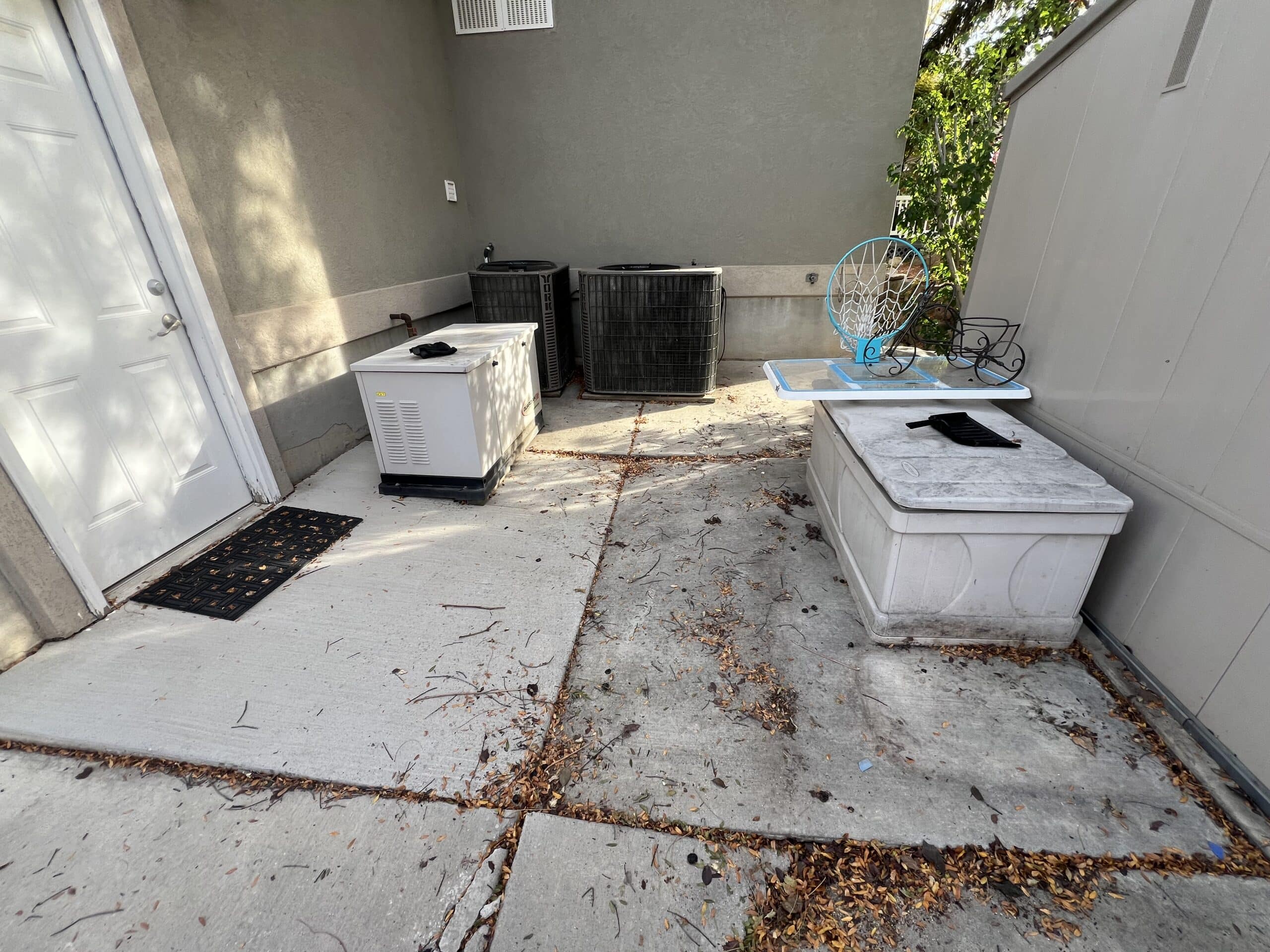
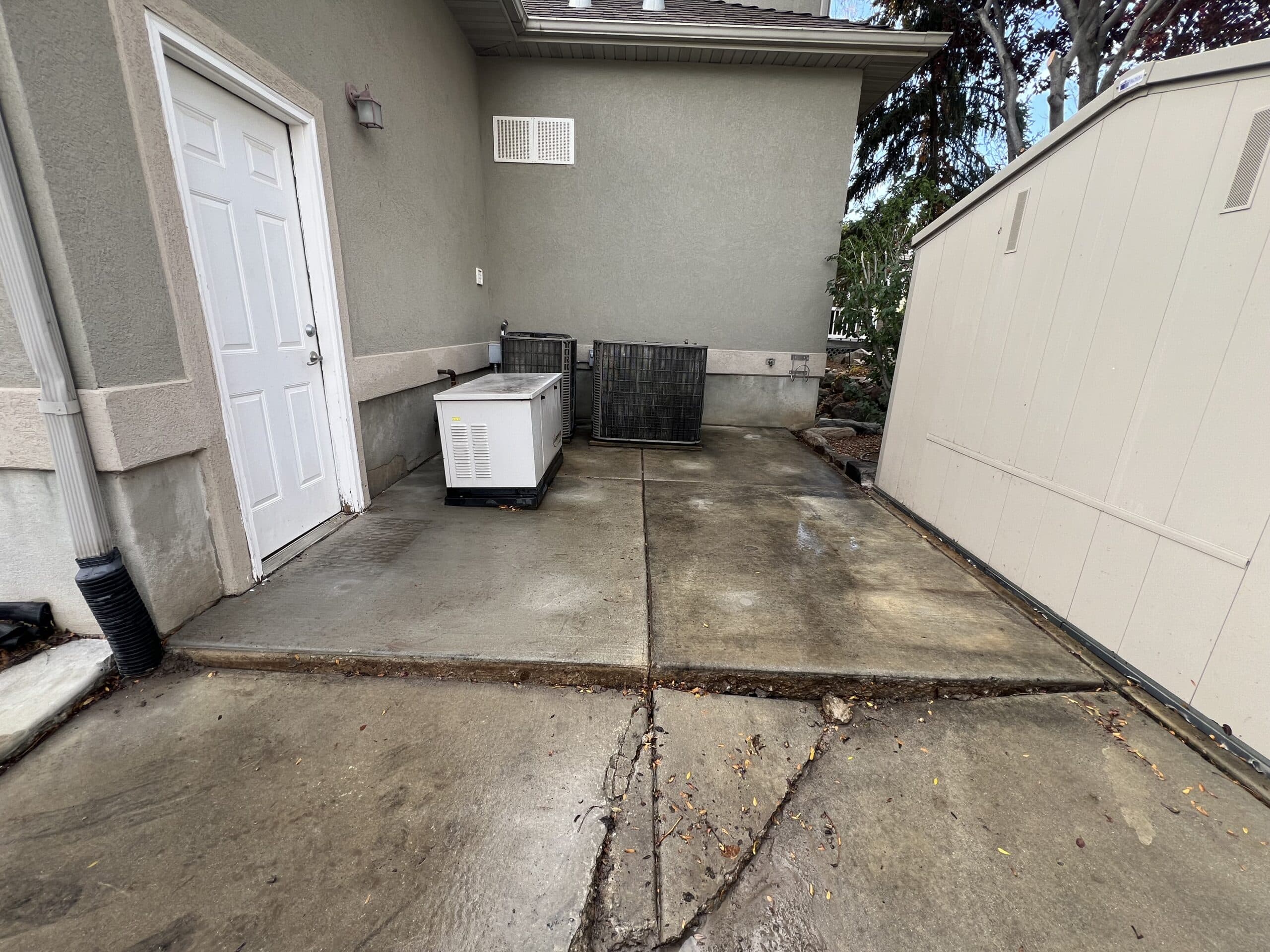
The utility pads behind this South Jordan home's garage had settled roughly three inches over the years. The homeowner was preparing to pour a new RV pad on the same side of the property and wanted everything back to grade before that work started. We lifted the existing utility pads in a single visit, ready for the next phase.
This is exactly the kind of slab settlement we see across South Jordan, especially in homes that have been in place ten to twenty years and never had the soils touched since the original build.
Across hundreds of projects, these are the slabs we lift most often:
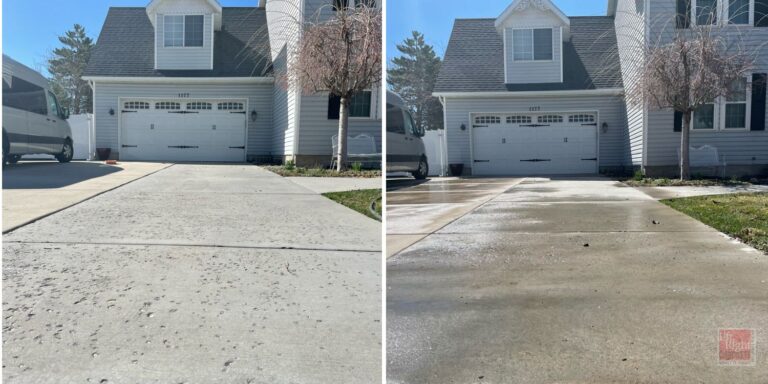
The most common job. Driveways settle at the garage joint, creating a step and a snow-shoveling nightmare.
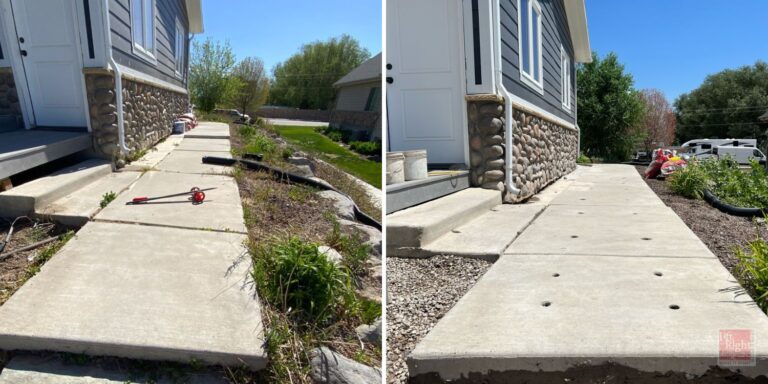
Public sidewalk panels and front walkways with lifted or dropped joints.
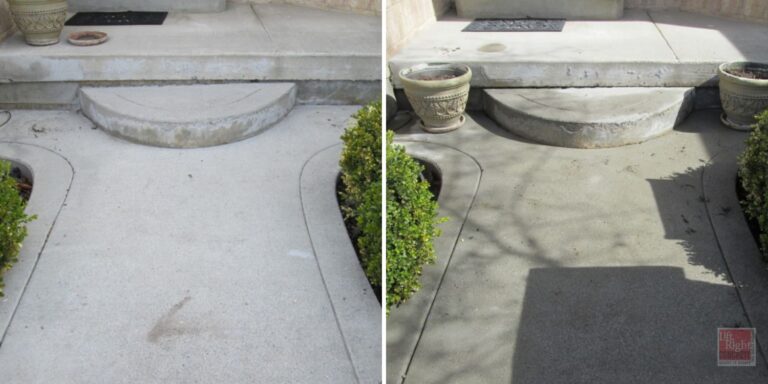
Front steps and landings where settlement creates a hazard right at the door.
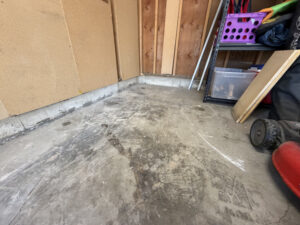
Interior slab repair when a corner has dropped or cracks have widened.
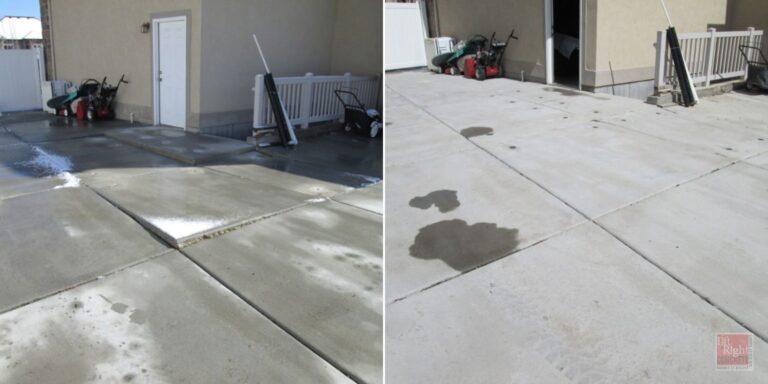
Back patios leveled when they're pitching toward the house or pooling water.
We've completed projects across South Jordan's 84009 and 84095 ZIP codes, in both the planned Daybreak community on the west side and the original South Jordan neighborhoods east of Bangerter Highway:
If you're in a South Jordan neighborhood we didn't list, call us anyway. We work the entire city.
We offer both. See the full comparison.
For most South Jordan jobs we now recommend polyurethane foam. The injection holes are smaller, the foam cures in about 15 minutes (so you can drive on the slab the same day), and it weighs roughly 1/20th of mudjacking slurry. That weight difference matters here. Most of South Jordan's settled slabs are sitting on disturbed soil that's already moved once. Polyfoam doesn't add hundreds of pounds back on top of ground that's already struggling.
We still use mudjacking when it's the right call: larger slabs, deep voids, or jobs where budget is the deciding factor. The cement-based slurry has been proven in Utah for decades and lifts concrete reliably at a lower price point than foam.
When we come out to look at your job, we'll tell you which method we'd use on your specific slab and explain why. You'll get a written estimate either way.
Quick answers to what South Jordan homeowners ask before they call.
If we used polyurethane foam, the foam cures in about 15 minutes and you can drive on the slab the same day, often within an hour of us packing up. If we used mudjacking, we ask you to wait 24 hours before driving heavy vehicles across the slab to let the cement-based slurry set.
Yes, where possible. For driveways: move any vehicles, trailers, or RVs off the slab and out of the workspace. For patios and slab pads: move outdoor furniture, planters, grills, and anything else light enough to move easily. We'll handle the rest. If something's too heavy or awkward, leave it and we'll work around it.
We work year-round. Spring through fall is generally easiest because the ground is fully thawed and we have predictable working days, but we can lift in winter as long as the ground under the slab isn't frozen and the slab itself hasn't frost-heaved (concrete that has lifted from frozen soil expansion needs to settle back down before we can level it).
Freezing temperatures and frozen ground are the only things that actually stop us. For everything else (rain, wind, cold short of freezing), we work around it when we can, and through it when we need to.
Both. We choose the method based on the slab and the conditions, not based on what we have on the truck that day. Polyurethane foam is our default for most South Jordan jobs because it's lightweight, cures fast, and is less invasive. Mudjacking (cement-based grout) is the right call for larger slabs, deep voids, and budget-sensitive jobs. We'll tell you which we'd use when we come out, and explain why.
Usually yes. Cracks alone don't stop us from lifting. Where we draw the line: if the slab is broken into more than three pieces, or if any of those pieces are smaller than about four square feet, it gets hard to level out and replacement is usually the better call. We'll tell you which when we come out to look.
If the slab is exposed to water (driveway, walkway, patio, pool deck), we'll usually recommend sealing the joints and cracks after the lift. That keeps moisture from getting under the slab and restarting the settlement cycle. We can typically handle the sealing the same day.
A properly lifted slab should hold for the remaining life of the concrete, assuming the soil underneath stays stable. We offer warranty coverage on the work itself, with extended terms on deeper polyfoam installations. We'll go through the warranty options at the estimate.
The injection holes get patched at the end of the lift. Polyurethane patches usually start blending in within a day. Mudjacking patches take a few weeks to weather in and match the surrounding concrete.
During polyurethane work we use a release agent on the slab to prevent foam residue from staining the surface. We do our best to clean up the work area before we leave.
Lifting is typically about half the cost of tearing out and replacing the slab, sometimes less for smaller jobs. You also keep your existing concrete, which means the matched color and texture stays consistent with the rest of your slabs. The exact number depends on the size of the slab and how much lift it needs, so we come out and look at the job in person before quoting. The estimate is free and you'll get a firm written price before any work starts.
Different problems, different fixes. Slab settlement is when concrete around the foundation drops: driveways, walkways, patios, slab pads, garage floors. The slab moves but the house doesn't. We lift those with mudjacking or polyurethane foam.
Foundation settlement is when the foundation itself moves. The usual signs are cracks in the foundation, cracks running through interior or exterior walls, and doors or windows that go out of plumb or get hard to open and close. That needs a different approach: helical piers, push piers, or deep ground injection to lift and stabilize.
We do both. When we come out, we'll look at the slab and the foundation and tell you which problem you have. If you've already spotted foundation signs, you can also read more about our foundation repair services.
The injection holes are small (about the diameter of a penny for polyfoam, slightly larger for mudjacking) and the work happens on top of the slab, not in your yard. We patch the holes when the lift is done. We do ask that you flag any sprinkler heads near the slab edges so we can avoid them. If we need to work right next to a planted bed, we'll talk through it with you before we start.
We handle that too. Helical piers, push piers, and deep ground injection for foundations, porches, and other structures that have moved. Same approach as our concrete lifting: family-owned, honest estimate first, no upsells.
We'll come out to your South Jordan property, look at the slab, and give you a firm written estimate before any work happens. No pressure, no upsells, no obligation.
Request a Quote